So, does Wisconsin have good air quality compared with other states? It's moderately good, but it isn't among the best. The state ranks 39th for fine particle exposure, just under the national average, while the Milwaukee metro earns failing grades for ozone smog. Your county and the season tell you far more than any statewide rank.
Wisconsin stretches from the Lake Superior shore down to the Illinois line. Dense forest covers the north while an industrial Lake Michigan coastline anchors the southeast. Nearly everything below traces back to that split.
TL;DR Quick Answers
Air Quality Wisconsin
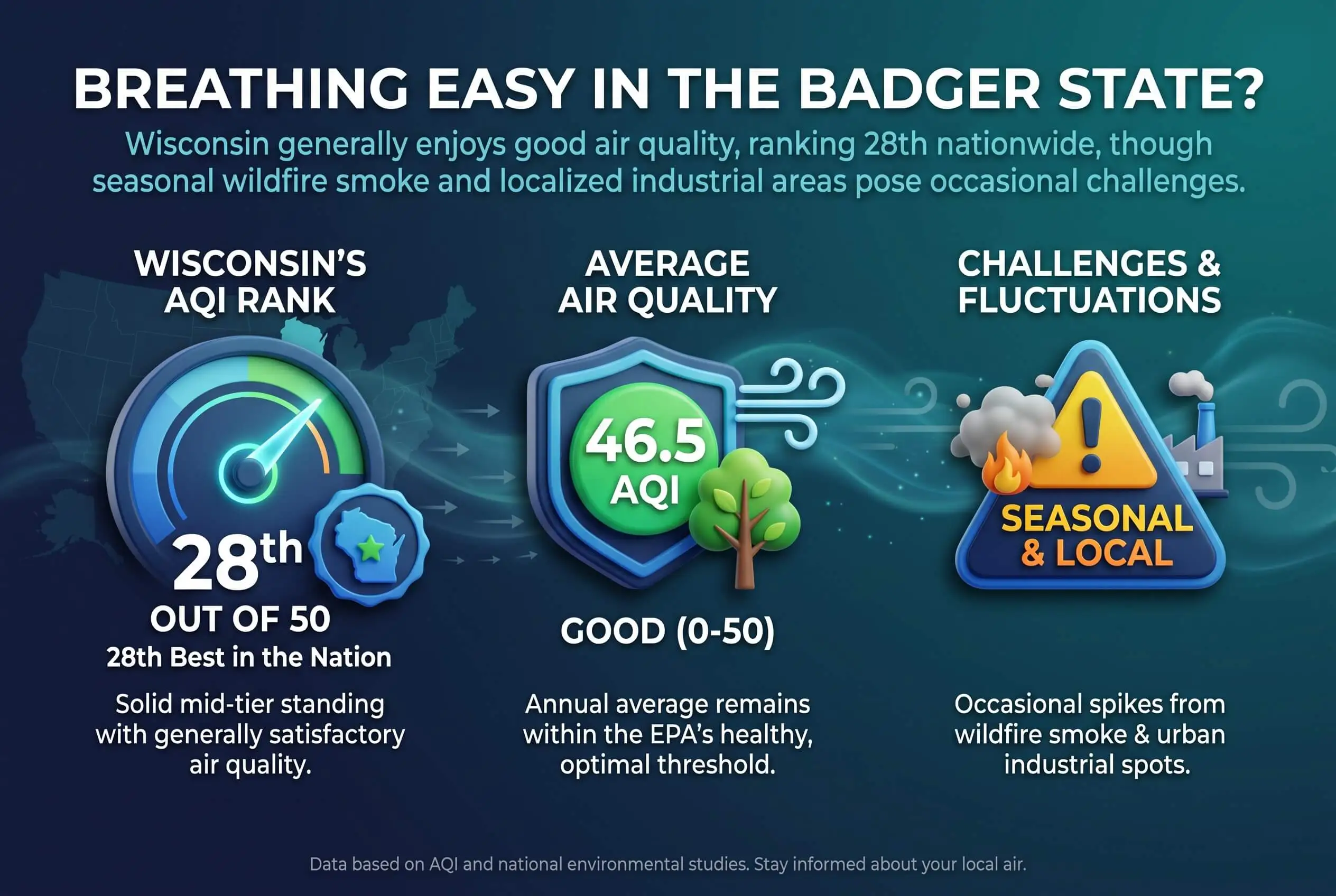
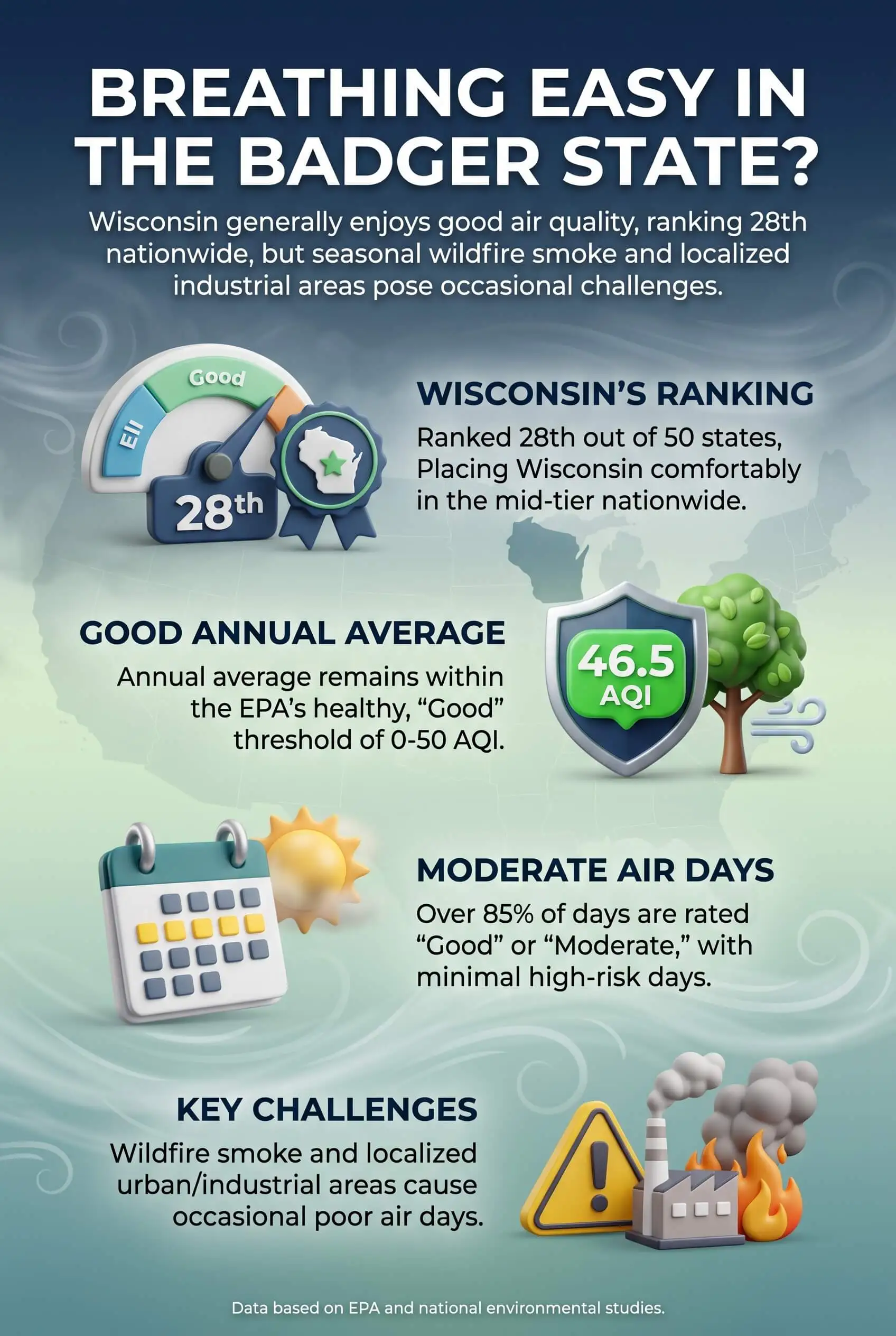
Air quality in Wisconsin is moderately good but not among the nation’s best. The state ranks 39th for fine particle exposure at 8.6 micrograms per cubic meter, just under the U.S. average of 8.8. The Milwaukee lakeshore fails for ozone, northern counties stay cleaner, and wildfire smoke sets records in July 2026.
National rank: 39th of 50 for PM2.5, ahead of Illinois at 47th and Michigan at 48th.
Weakest spot: The Milwaukee-Racine-Waukesha metro ranks 22nd worst in the U.S. for ozone.
Cleanest region: Northern Wisconsin, away from the Lake Michigan metros.
Biggest wild card: Wildfire smoke from Canada and Minnesota pushed readings past 500 in July 2026.
Hidden risk: Ozone can reach unhealthy levels on bright, clear days with no visible haze.
Indoor protection: Close windows once the AQI passes 100, set the fan to On and use a MERV 8 filter.
Top Takeaways
Middle of the pack: Wisconsin ranks 39th for fine particle exposure, just under the national average.
Ahead of most neighbors: Illinois and Michigan score worse, while Minnesota and Iowa come out slightly cleaner.
A divided state: The southeastern lakeshore fails for ozone, and northern counties post some of the cleanest air in Wisconsin.
Smoke is the wild card: July 2026 brought some of the worst wildfire smoke the DNR has ever recorded.
Indoor air follows outdoor air: Closed windows, a running fan and a fine-particle filter protect your family on bad days.
How Does Wisconsin's Air Quality Rank Nationally?
America's Health Rankings uses EPA data to score all 50 states on the fine particle pollution, or PM2.5, people breathe on average. For 2022 through 2024, Wisconsin averaged 8.6 micrograms per cubic meter and placed 39th. The U.S. figure was 8.8. Wyoming had the cleanest air at 4.1, and California the dirtiest at 11.7.
Here's something that might surprise you. Wisconsin beats the national average and still sits in the bottom quarter. Big, crowded states drag the U.S. number up, and in the crowded middle a few tenths of a microgram can shuffle a state many spots.
Wisconsin has slipped, too. It ranked 22nd in the 2023 report, and the newer data window takes in the summer of 2023, when Canadian wildfire smoke pushed particle levels up across the Midwest.
How Wisconsin Compares With Its Neighbors
Same measure, same years:
Minnesota and Iowa: 8.4, tied for 32nd
Wisconsin: 8.6, 39th
Illinois: 10.3, 47th
Michigan: 10.4, 48th
Regionally, Wisconsin looks good. Nationally, it's middle of the road at best.
Why Do Air Quality Rankings Disagree?
State rankings average a full year of exposure. County report cards, including the American Lung Association's State of the Air, count unhealthy days instead. A county with a perfectly decent yearly average can still fail on the strength of a few bad summer afternoons, and that's the story along Lake Michigan.
Where Is Wisconsin's Air Cleanest, and Where Does It Struggle?
The State of the Air 2026 report covers 2022 through 2024, and it draws a clear line across the state.
Ozone: The Milwaukee-Racine-Waukesha metro ranked 22nd worst in the nation and earned an F. Racine County logged 10.7 unhealthy ozone days a year on average.
Short-term particle spikes: The metro ranked 46th worst here, another F, and Milwaukee County averaged 3.8 unhealthy days a year.
Year-round particles: Milwaukee County passed, with levels under the federal standard.
Farther up the shore, Sheboygan, Manitowoc and Door counties have drawn failing ozone grades in recent reports. Head north and the picture flips. Ashland County, on Lake Superior, was the only Wisconsin county to earn an A in 2026.
What Affects Air Quality in Wisconsin?
Ozone That Travels Up the Lakeshore
Ozone forms when exhaust and industrial emissions cook in heat and sunlight, according to the National Weather Service. On hot summer days, those pollutants can ride north along Lake Michigan and settle over shoreline towns. The Wisconsin DNR has said much of that ozone comes from outside the state, and its 2024 trends report put the drop in shoreline ozone at 22 percent since the early 2000s.
Wildfire Smoke From Canada and Minnesota
Smoke from fires hundreds of miles away rides the jet stream south and sinks to ground level. The DNR has tied the state's high particle readings in recent years to Canadian wildfires, which puts smoke behind many of Wisconsin's worst air days.
Winter Temperature Inversions
Cold, still mornings bring their own problems. Warmer air caps the cooler air near the ground and holds wood smoke and exhaust at breathing height.
Seasonal Farm Dust
Spring planting and fall harvest kick up coarse farm dust.
Was 2026 a Record Year for Wildfire Smoke in Wisconsin?
For a few days in July, it was. The DNR issued a statewide air quality advisory on July 14, 2026, as smoke from fires in northern Minnesota and Canada rolled in. By July 15 and 16, DNR staff were calling it some of the worst wildfire smoke the agency had ever measured.
Index values broke the June 2023 record of 273 and climbed well past 500 in several parts of the state. The smoke lingered longest in the north and east.
What Does Wisconsin's Air Quality Mean for Your Health?
Bad air doesn't always look bad. A bright July afternoon on the lakeshore can carry unhealthy ozone without a trace of haze. Even with regular duct cleaning, it's important to check outdoor air quality before opening your windows.
Ozone irritates the lungs and can set off asthma attacks. Fine particles travel deep into the lungs, and the CDC links them to heart attacks and strokes. The American Lung Association counts 802,686 Wisconsin children breathing unhealthy air.
These are the people who tend to feel it first:
Children and teens
Adults over 65
Anyone living with asthma, COPD or heart disease
Outdoor workers, runners and anyone else who exercises outside
How Can You Check Air Quality in Wisconsin Today?
The Air Quality Index boils pollution readings down to one number between 0 and 500. Green means good up to 50, and yellow means moderate up to 100. Orange, from 101 to 150, is where sensitive groups should ease off. At red or higher, everyone should. I check a live map before outdoor plans on hot afternoons and during any smoke advisory.
How Can You Protect Indoor Air When Outdoor Air Turns Unhealthy?
Don't take your indoor air for granted. Shutting the windows slows outdoor pollution down, but your home keeps trading air with the outdoors through gaps and ductwork all day long. Using mastic duct sealant to seal leaky ductwork can help reduce unwanted air leakage.
Close up past 100: Shut windows and doors once the AQI turns orange.
Run the fan: Switch the thermostat fan from "Auto" to "On" so air keeps moving through the filter.
Upgrade the filter: Go with MERV 13 if your system can handle it. It catches far more fine smoke particles.
Check it often: During a smoke advisory, look at the filter every few days instead of every few months.
Add a portable cleaner: Put a HEPA unit in a bedroom so sensitive family members have a cleaner room to rest in.
Pro Tip: Make the smoke-season filter check as routine as checking the forecast. It takes a minute, and it shows you how hard your system is working to protect your family. Regular maintenance for air conditioning systems also helps keep your filtration working effectively during smoke season.
"After a week of smoking along the Lake Michigan shore, I can usually spot the difference before I even pull a filter out: a gray film across pleats that looked clean days earlier. Fine smoke particles load a filter much faster than household dust, so during an advisory I check every few days instead of waiting for the usual change date."
7 Essential Resources
Live Air Quality Index Map for Wisconsin: Real-time AQI and PM2.5 readings for Wisconsin regions, with tips for high-AQI days.
Wisconsin DNR Air Quality: The state's monitoring network, forecasts, smoke guidance and long-term trends.
America's Health Rankings: Air Pollution in Wisconsin: Where Wisconsin's fine particle exposure ranks against every other state.
Wisconsin DHS: Air Quality Issues: State health advice on portable air cleaners, HVAC filters, radon and asthma triggers.
CDC: About Air Quality: Planning activities around the AQI and protecting the people most at risk.
National Weather Service: Why Air Quality Is Important: How ozone and particles form, and why daily forecasts matter.
Wisconsin Public Radio: Worst Smoke on Record: On-the-ground coverage of the July 2026 smoke event and the DNR's advice.
3 Supporting Statistics
The Milwaukee-Racine-Waukesha metro ranks 22nd worst in the U.S. for ozone, and 802,686 Wisconsin children breathe unhealthy air. American Lung Association: State of the Air 2026, Wisconsin
During the July 2026 smoke event, Wisconsin's index values topped the June 2023 record of 273 and passed 500 in several areas. Wisconsin Watch: July 2026 Wildfire Smoke
Americans spend about 90 percent of their time indoors, where some pollutants run 2 to 5 times higher than typical outdoor levels. EPA Report on the Environment: Indoor Air Quality
Final Thoughts and Opinion
Here's my honest take. Wisconsin's air is better than its lakeshore grades make it sound and worse than its northern forests make it look. A rank of 39th feels alarming until you notice Illinois and Michigan trailing behind. And a passing yearly average feels reassuring right up until you count Milwaukee's orange ozone afternoons.
Along Lake Michigan, I'd take summer ozone forecasts seriously. Up north, the bigger threat now is smoke from fires hundreds of miles away. Wherever you live, your county's reading today is the number worth knowing.
Frequently Asked Questions
Is Wisconsin's Air Quality Better Than Illinois or Minnesota?
It beats Illinois and trails Minnesota by a hair. For 2022 through 2024, Wisconsin averaged 8.6 micrograms of fine particles per cubic meter and ranked 39th. Illinois averaged 10.3 and ranked 47th. Minnesota came in at 8.4 and tied for 32nd.
Why Does Milwaukee Get Failing Grades for Ozone?
Ozone builds on hot, sunny days as emissions from the metro and states to the south react along the lakeshore. The American Lung Association grades counties on unhealthy days, and Racine County averaged 10.7 of them a year, enough to rank the whole metro 22nd worst in the country.
Which Part of Wisconsin Has the Cleanest Air?
Northern Wisconsin usually posts the cleanest readings. The catch is that wildfire smoke often reaches the north first.
How Does Wildfire Smoke Affect Air Quality in Wisconsin?
Smoke loads the air with fine particles that can push the AQI from good to hazardous within hours. In July 2026, readings broke the 2023 record and topped 500 in places. Smoke seeps indoors too, so closed windows and a high-efficiency filter matter.
What AQI Level Is Unsafe for Outdoor Activity in Wisconsin?
Once the AQI passes 100, children, older adults and people with asthma should cut back on long or hard outdoor exertion. Past 150, that advice covers everyone. Above 300, conditions turn hazardous and staying inside is the safest call.
Know Your Local Air Before You Trust a State Ranking
Whether Wisconsin has good air quality comes down to your county and the season more than any statewide score. Check today's air quality index reading where you live, and keep your home's filtration ready so your family breathes easier through the next ozone afternoon or smoke advisory.