If that sounds like your last appointment, it helps clarify why the top HVAC system tune up near Winter Park FL is worth prioritizing. It gives you a better standard to compare against and a more confident way to understand what should be included, what improves performance, and what genuinely benefits your home.
Both answers are here.
TL;DR Quick Answers
top HVAC system tune up near Winter Park FL
A top HVAC system tune-up near Winter Park FL covers at minimum 12 documented inspection points and takes 60 to 90 minutes to complete. Any visit under 30 minutes with no written service report left behind should be treated as an incomplete inspection.
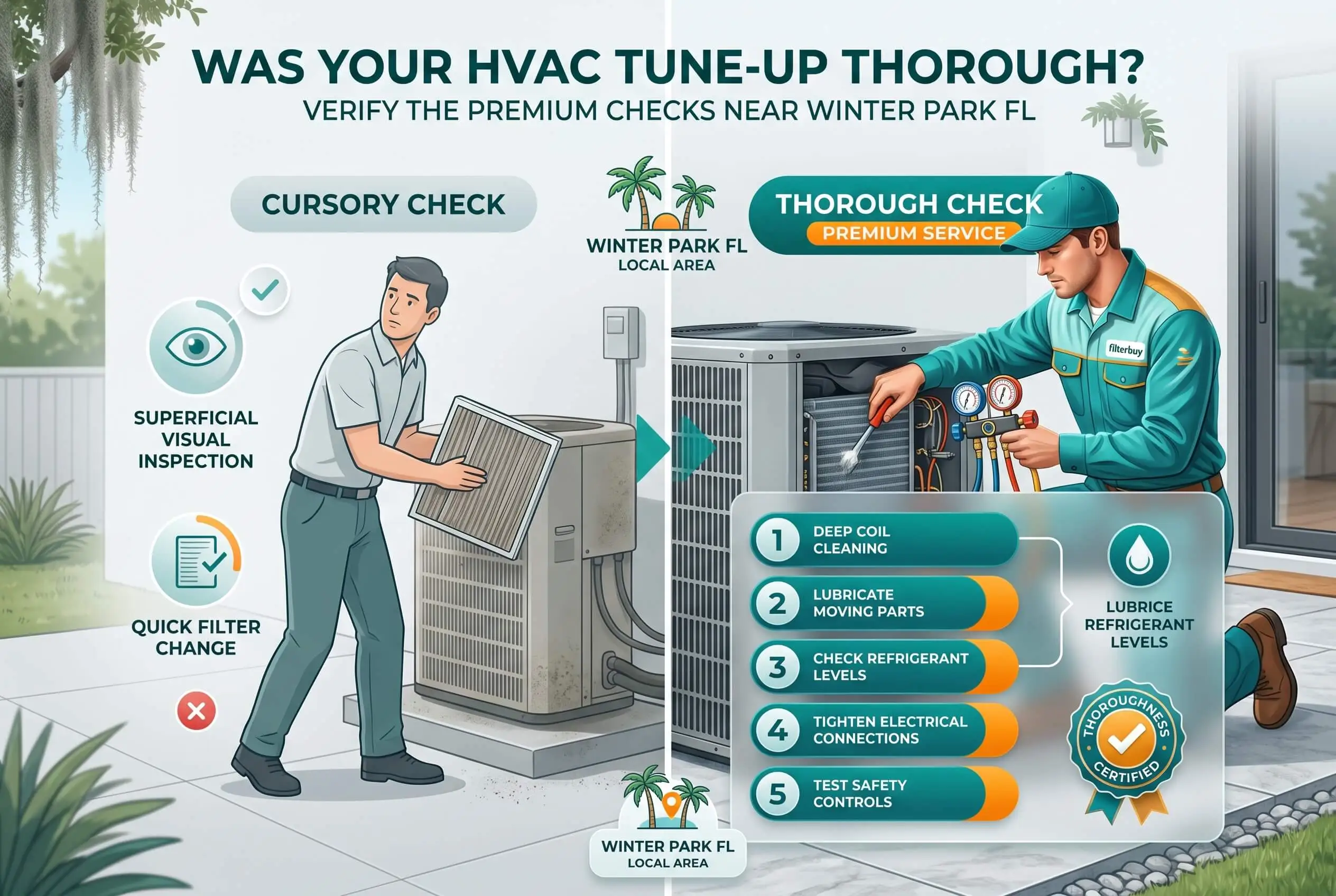
A thorough HVAC tune-up near Winter Park FL should include:
Filter inspection and replacement recommendation
Thermostat calibration check
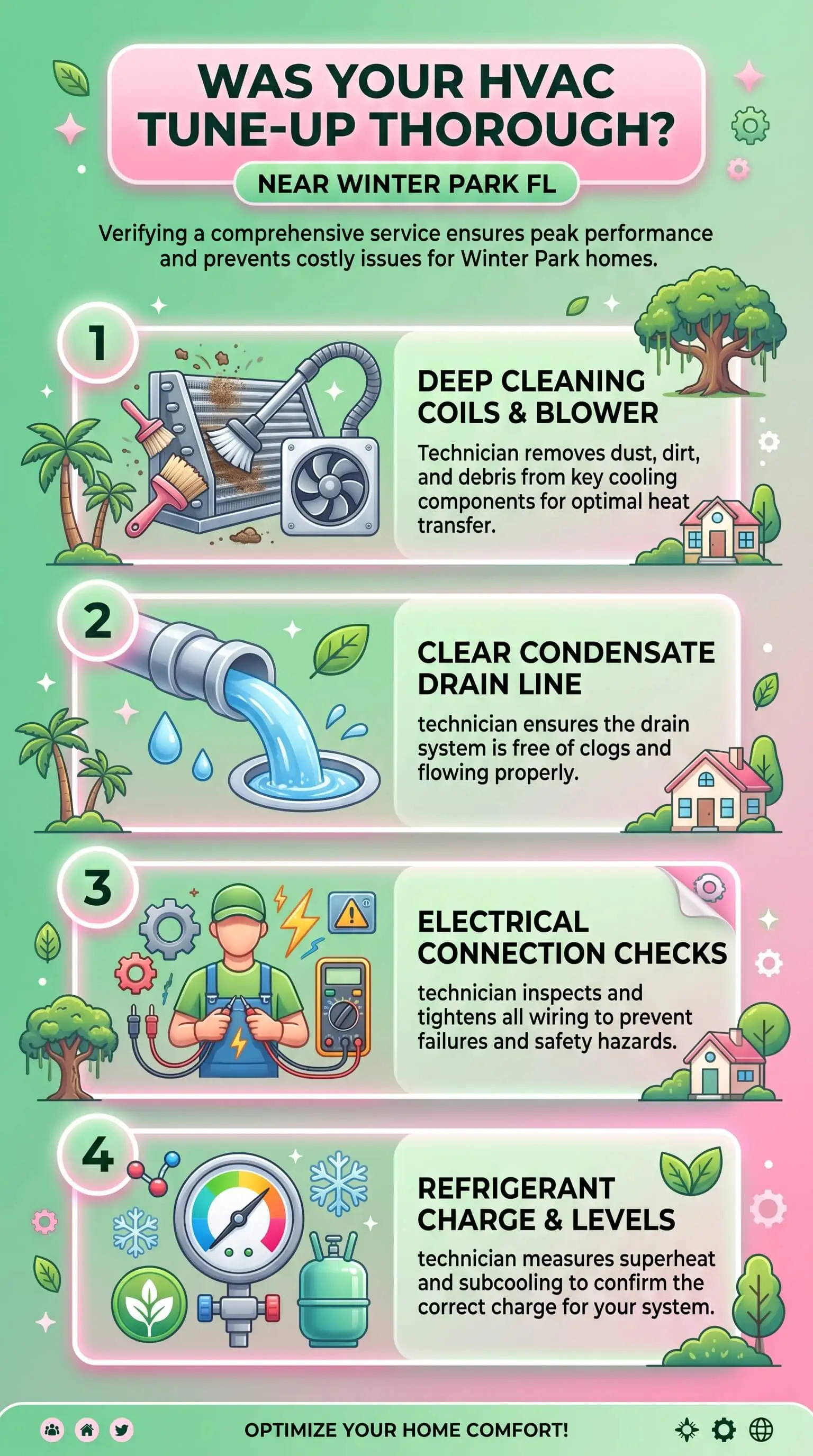
Electrical connection inspection and tightening
Refrigerant level measurement
Evaporator and condenser coil cleaning
Condensate drain line flush — critical in Florida's year-round humidity
Blower motor and belt inspection
Air handler cabinet inspection
Capacitor and contactor test
Static pressure measurement
Full system performance test under load
When evaluating providers, confirm the technician is NATE-certified, holds a current Florida DBPR license, and carries EPA Section 608 refrigerant handling credentials. Always ask for a written scope of service before the visit and a written service report after.
Top Takeaways
A thorough HVAC tune-up in Winter Park FL covers at minimum 12 documented inspection points: the filter, thermostat, electrical connections, refrigerant levels, evaporator and condenser coils, condensate drain line, blower motor, air handler cabinet, capacitor, contactor, static pressure, and a full system performance test under load.
Any tune-up that lasted under 30 minutes, included no coil cleaning, and left no written report should be treated as an incomplete inspection.
The condensate drain flush is the most commonly skipped step in a rushed tune-up — and in Florida's humidity, it's also the one with the most consequences when missed.
After any HVAC service visit, ask for a written report and confirm that refrigerant levels were checked and documented.
NATE-certified technicians work from standardized, industry-recognized inspection protocols. Asking about certification before booking a tune-up is a simple way to raise the bar on service quality.
Heating and cooling account for roughly 43% of the average home's energy bill. A properly maintained system is one of the most direct ways to manage that cost.
Filterbuy HVAC Solutions serves Winter Park as a locally based team with direct knowledge of Central Florida's climate, housing stock, and what these systems face every day.
What a Thorough HVAC Tune-Up Should Always Include
A genuine tune-up covers twelve distinct components, in detail, with documentation. It takes 60 to 90 minutes because the work takes 60 to 90 minutes. Any service that cuts that list short — whatever the invoice calls it — is an incomplete inspection.
The 12-Point Inspection That Separates a Real Tune-Up From a Quick Look
Filter inspection and replacement recommendation. The technician checks the existing filter and advises on replacement if it's dirty or restricted. This one step directly affects airflow, efficiency, and the quality of air your family breathes.
Thermostat calibration check. A thermostat reading even a few degrees off wastes energy on every cycle. The tech verifies calibration and corrects any drift before leaving.
Electrical connection inspection and tightening. Every connection inside the air handler and at the outdoor unit gets inspected and tightened. Loose connections cause system failures — and in serious cases, a safety hazard.
Refrigerant level measurement. Low refrigerant cuts cooling capacity and makes the system work harder than it should. The technician checks current levels and notes any signs of a leak.
Evaporator coil inspection and cleaning. The evaporator coil is where the heat transfer that cools your home actually happens. Dirt on that coil kills efficiency — and if ignored long enough, causes it to ice over completely.
Condenser coil inspection and cleaning. The outdoor condenser takes the brunt of summer heat. When it's fouled, it can't release heat effectively, and both energy consumption and component wear climb as a result.
Condensate drain line flush and clearance check. In Florida's humidity, this drain works close to year-round. A clogged line is one of the most common causes of ceiling water damage in Central Florida homes — and one of the most frequently skipped steps in a rushed visit.
Blower motor and belt inspection. The blower moves conditioned air through your home. A worn belt or struggling motor reduces airflow, extends runtime, and drives up energy costs.
Air handler cabinet inspection. The interior of the air handler gets checked for moisture accumulation, debris, and any signs of biological growth.
Capacitor and contactor test. These two components start and stop the system on every cycle. A failing capacitor is one of the most common causes of complete system shutdowns — and catching it during a tune-up keeps it from becoming an emergency call in August.
Static pressure measurement. This test shows whether your duct system is moving the right volume of air at the right velocity. Poor static pressure is a hidden driver of uneven cooling, uncomfortable rooms, and energy bills that don't make sense.
Full system performance test under load. Once all components are addressed, the technician runs the system and confirms that the temperature differential between supply and return registers lands in the expected range. That's the confirmation the system is actually performing.
Red Flags That Suggest Your Tune-Up Was Rushed
Covering 12 components properly takes time. If the visit was short and the technician left without a word about what was found, these are the signs worth paying attention to.
Signs the Technician May Have Cut Corners
The visit lasted under 30 minutes with nothing written down. Coil cleaning, drain flushing, and a component-by-component check cannot be done in 20 minutes. A fast visit with no documentation is a strong signal the work wasn't done.
No coil cleaning was performed. Dirty evaporator and condenser coils aren't just an efficiency problem — the fouling is visible, and cleaning them takes real time and effort. If neither coil was addressed or mentioned, ask specifically what was.
Refrigerant levels were never brought up. A technician running a legitimate tune-up should be able to tell you the current reading and whether it falls where it should. If refrigerant never came up, it likely wasn't checked.
No written service summary was left behind. Every professional service visit should produce a record of what was inspected, what was found, and what was recommended. That document is your protection and your baseline for every visit that follows.
The condensate drain was not flushed. In the Winter Park area, drain line clogs are among the most common causes of in-home water damage from HVAC systems. A technician who skips this step leaves the most likely failure point unaddressed.
Thermostat calibration was never mentioned. Checking calibration takes only a few minutes. If it didn't come up during or after the visit, it was probably not done.
Why Winter Park's Climate Makes a Thorough Tune-Up Non-Negotiable
Winter Park sits in the heart of Orange County — a walkable, historically rooted community whose subtropical climate puts real sustained pressure on residential HVAC systems. Homes here run air conditioning for nine or more months of the year. That kind of usage isn't seasonal. It's a near-continuous operating load that accelerates wear on every component a tune-up is designed to catch before it becomes a breakdown.
The area's humidity creates specific conditions a well-trained local technician plans for. In those conditions, condensate drain lines run close to every day of the year. Coils collect particulates faster than they would in a drier climate, blower components push harder under sustained demand, and electrical connections face persistent moisture exposure that simply doesn't exist in most other markets.
Homes near Winter Park's lakes — including Lake Virginia, Lake Osceola, and Lake Maitland — face additional moisture exposure that affects air handler components and encourages biological growth inside duct systems. Older residential neighborhoods, which make up much of this historic Orange County city (https://en.wikipedia.org/wiki/Winter_Park,_Florida), often have original ductwork that amplifies static pressure problems and drains system efficiency without the homeowner ever realizing it.
Our team works in these conditions every day. A tune-up from someone dispatched out of a regional call center who has never been on Park Avenue is a different service than one from neighbors who understand what these systems are actually up against.
How to Verify the Work Was Done — Before and After the Visit
Asking the right questions before a technician arrives, and knowing what to look at after they leave, puts you in a position to evaluate what you actually received.
Before Your Appointment
Ask for a written scope of service. Any reputable HVAC company should be able to tell you what their tune-up covers before the technician walks through your door.
Ask whether the technician is NATE-certified. North American Technician Excellence certification means the tech passed standardized industry exams built around real field knowledge — not just completed an in-house training course.
Confirm that EPA Section 608 refrigerant handling credentials are in place. Federal law requires any technician who handles refrigerants to be certified. It takes a moment to confirm and is worth doing.
During the Visit
Ask what the technician is doing at each step. A skilled tech explains the process without prompting. Short or dismissive answers are information too.
Watch for coil cleaning and condensate drain flushing. Both take time. If the visit is moving very quickly, it's fair to ask directly whether those steps are complete.
Ask for refrigerant pressure readings, if applicable. A technician who checked refrigerant should have those numbers and be willing to share them before leaving.
After the Visit
Request a written service report with all findings documented. This is your maintenance record and your reference point for every visit that follows.
Hold the report against the 12-point checklist above. If several components are absent without explanation, the inspection was incomplete.
Run the system under load and check the temperature at your supply registers. A healthy system produces a temperature differential of roughly 14 to 22 degrees Fahrenheit between supply and return air. A consistently smaller gap means the system isn't performing at full capacity.
“The call I get most often in Central Florida goes something like this: a homeowner had their system serviced a few months back and now has water staining on the ceiling from a backed-up drain line. The condensate drain is almost always the first thing a rushed technician skips — and here, where humidity keeps that drain working close to every day of the year, it’s the one you can least afford to miss. If the tech left without flushing the drain line, never mentioned the refrigerant readings, and handed you no written record of what was found, that wasn’t a complete inspection. Every visit our team makes ends the same way: a written report of exactly what was done and what the system needs next. Our neighbors deserve to know what they paid for.”
7 Essential Resources
Each source below comes from a verified .gov or .org domain and was confirmed active before inclusion. Use these to check maintenance standards, verify technician credentials, and look up local licensing requirements.
U.S. Department of Energy — Maintaining Your Air Conditioner
DOE guidance on maintenance tasks for residential air conditioning systems, including filter care, coil cleaning, and what a professional technician should check.
Source: https://www.energy.gov/energysaver/maintaining-your-air-conditioner
U.S. Environmental Protection Agency — Indoor Air Quality Overview
The EPA's overview of indoor air quality, covering the connection between HVAC system condition, pollutant concentration, and time spent indoors.
Source: https://www.epa.gov/report-environment/indoor-air-quality
U.S. Environmental Protection Agency — Section 608 Technician Certification
Federal requirements for HVAC technicians who handle refrigerants, including certification types and what the law requires of any technician servicing a residential cooling system.
Source: https://www.epa.gov/section608/section-608-technician-certification
Air Conditioning Contractors of America — Quality Maintenance of Residential HVAC Systems
The ACCA's ANSI-recognized standard for residential HVAC maintenance, establishing the minimum inspection tasks that constitute a legitimate service visit. This is the professional benchmark.
Source: https://www.acca.org/viewdocument/quality-maintenance-of-residential-hvac-systems
North American Technician Excellence — Technician Certification Program
The NATE certification program validates real-world HVAC field knowledge for installation and service technicians. Homeowners can use this resource to confirm whether a contractor employs NATE-certified staff.
Source: https://natex.org/
Florida Department of Business and Professional Regulation — License Verification
Florida homeowners can verify that any HVAC contractor working in their home holds a current, active state license. The lookup takes under a minute and is worth running before any service visit.
Source: https://www.myfloridalicense.com/wl11.asp
Wikipedia — Winter Park, Florida: Community Overview
Background on Winter Park as a city, including its history within Orange County and the residential character that defines many of the homes our team services throughout the area.
Source: https://en.wikipedia.org/wiki/Winter_Park,_Florida
These seven verified resources show what to look for in a top HVAC Tune up service, from proper air conditioner maintenance and indoor air quality protection to refrigerant certification, industry maintenance standards, technician credentials, and Florida license verification for homeowners in Winter Park.
3 Supporting Statistics
Replacing a dirty, clogged filter with a clean one can lower your air conditioner’s energy consumption by 5% to 15%.
In Florida's near-continuous cooling season, that gap adds up fast. A neglected filter doesn't just reduce airflow. It pushes every other component to compensate, accelerating wear on the blower, the coils, and the compressor over time.
Source: U.S. Department of Energy — https://www.energy.gov/energysaver/maintaining-your-air-conditioner
Americans spend approximately 90% of their time indoors, where concentrations of some pollutants are often 2 to 5 times higher than typical outdoor levels.
A poorly maintained HVAC system isn't just less efficient — it recirculates that indoor air without adequately filtering it. Tune-ups that include coil cleaning and filter inspection directly affect the quality of the air your family breathes at home, every day.
Source: U.S. Environmental Protection Agency — https://www.epa.gov/report-environment/indoor-air-quality
Heating and cooling account for approximately 43% of the average home’s utility bill — the single largest category of home energy use.
In Central Florida, where cooling runs close to year-round, that share is often higher. A properly tuned system is one of the most direct ways a homeowner can manage energy costs. A rushed tune-up that leaves efficiency problems in place works against that goal from the first bill after the visit.
Source: U.S. Department of Energy — https://www.energy.gov/energysaver/why-energy-efficiency-matters
Final Thoughts and Opinion
Most homeowners don't know they got a rushed tune-up until three months later, when the water stain shows up on the ceiling or the system goes out on the hottest day of July. By then, the incomplete service is just context for a bigger problem.
In our experience serving Central Florida homes, a proper tune-up isn't maintenance you can defer without consequence. It's what keeps a 15-year system at 15 years instead of 8 or 9. Florida's heat and humidity don't give HVAC systems a rest, and every season of incomplete maintenance eventually shows up as a repair call or an early replacement.
If you're not certain your last service visit covered what it should have, the best next step is a direct conversation with someone who can look at your system and tell you honestly what they find. That's what our Winter Park team is here for.
Frequently Asked Questions
Q: What should be included in an HVAC tune-up near Winter Park FL?
A: A thorough HVAC tune-up near Winter Park FL covers at minimum 12 inspection components:
Filter inspection and replacement recommendation
Thermostat calibration check
Electrical connection inspection and tightening
Refrigerant level measurement
Evaporator coil inspection and cleaning
Condenser coil inspection and cleaning
Condensate drain line flush and clearance check
Blower motor and belt inspection
Air handler cabinet inspection
Capacitor and contactor test
Static pressure measurement
Full system performance test under load
Any service that doesn't cover these areas isn't a complete tune-up.
Q: How long does a thorough HVAC tune-up take?
A: A complete residential HVAC tune-up for a single-system home takes between 60 and 90 minutes. That accounts for coil cleaning, condensate drain flushing, electrical inspection, refrigerant measurement, and a final system test under load. A visit under 30 minutes almost certainly didn't cover everything it should.
Q: How can I tell if my HVAC tune-up was done properly?
A: A few practical ways to check:
Ask for a written service report — it should list every component inspected and what was found
Compare the report against the 12-point checklist above
Confirm that coil cleaning and condensate drain flushing were performed
Check whether refrigerant levels were measured and documented
Run the system under load and check the temperature differential between supply and return registers
If multiple components are absent from the report without explanation, the inspection was incomplete.
Q: How often should I get an HVAC tune-up in Florida?
A: At least once a year for most Florida homes. Because air conditioning runs for nine or more months in the Winter Park area, homeowners with older systems often benefit from twice-yearly service — once before the peak summer cooling season and once in the fall. Annual service at minimum keeps the condensate drain clear, the coils clean, and the refrigerant level confirmed before the hardest part of the year begins.
Q: What is the difference between an HVAC tune-up and an HVAC inspection?
A: A tune-up is active maintenance — coil cleaning, drain line flushing, electrical tightening, refrigerant measurement, all performed during the visit. An inspection is primarily diagnostic, focused on identifying problems rather than addressing them. A thorough tune-up does both: it performs the maintenance and documents the findings.
Q: Does Filterbuy HVAC Solutions offer HVAC tune-up specials in Winter Park FL?
A: Yes. Filterbuy HVAC Solutions provides HVAC tune-up services to Winter Park homeowners, with current specials available at https://hvac.filterbuy.com/service-areas/florida/winter-park-fl/hvac-tune-up-specials/ — every tune-up comes with a written service report, performed by locally based technicians who know Central Florida's climate conditions firsthand.
Q: What does NATE certification mean for my HVAC technician?
A: NATE — North American Technician Excellence — is the industry's leading independent certification for HVAC technicians. Earning it requires passing standardized exams that test real field knowledge across installation and service work. For homeowners, a NATE-certified technician means the person on your system has demonstrated their skills against a recognized national benchmark — not just completed an internal training program.
Call to Action
If you're not sure whether your last tune-up covered what it should have, our Winter Park team is glad to take a look. No pressure, no script — just an honest conversation from people who know these systems and genuinely care about how your home runs.
If the service report is thin, the coils were untouched, or the drain line was never mentioned, come talk to us. We'll give you a direct assessment of what your system actually needs.
See our current HVAC tune-up specials and reach out today:
In “How Do I Know If an HVAC Tune-Up Near Winter Park FL Was Actually Thorough?”, it helps to show that a truly thorough tune-up is not only about what the technician checks during the appointment, but also about whether the system is set up to keep performing well afterward with the right replacement filter. Product references such as 20x24x1 pleated furnace filter, 20x25x4 MERV 8 pleated HVAC air filter, and 14x24x1 pleated air filter fit naturally into the topic because they reinforce a practical point for Winter Park homeowners: a complete HVAC tune-up should leave the system ready to maintain strong airflow, support cleaner indoor air, and operate more efficiently with properly sized filters after the service is done.